
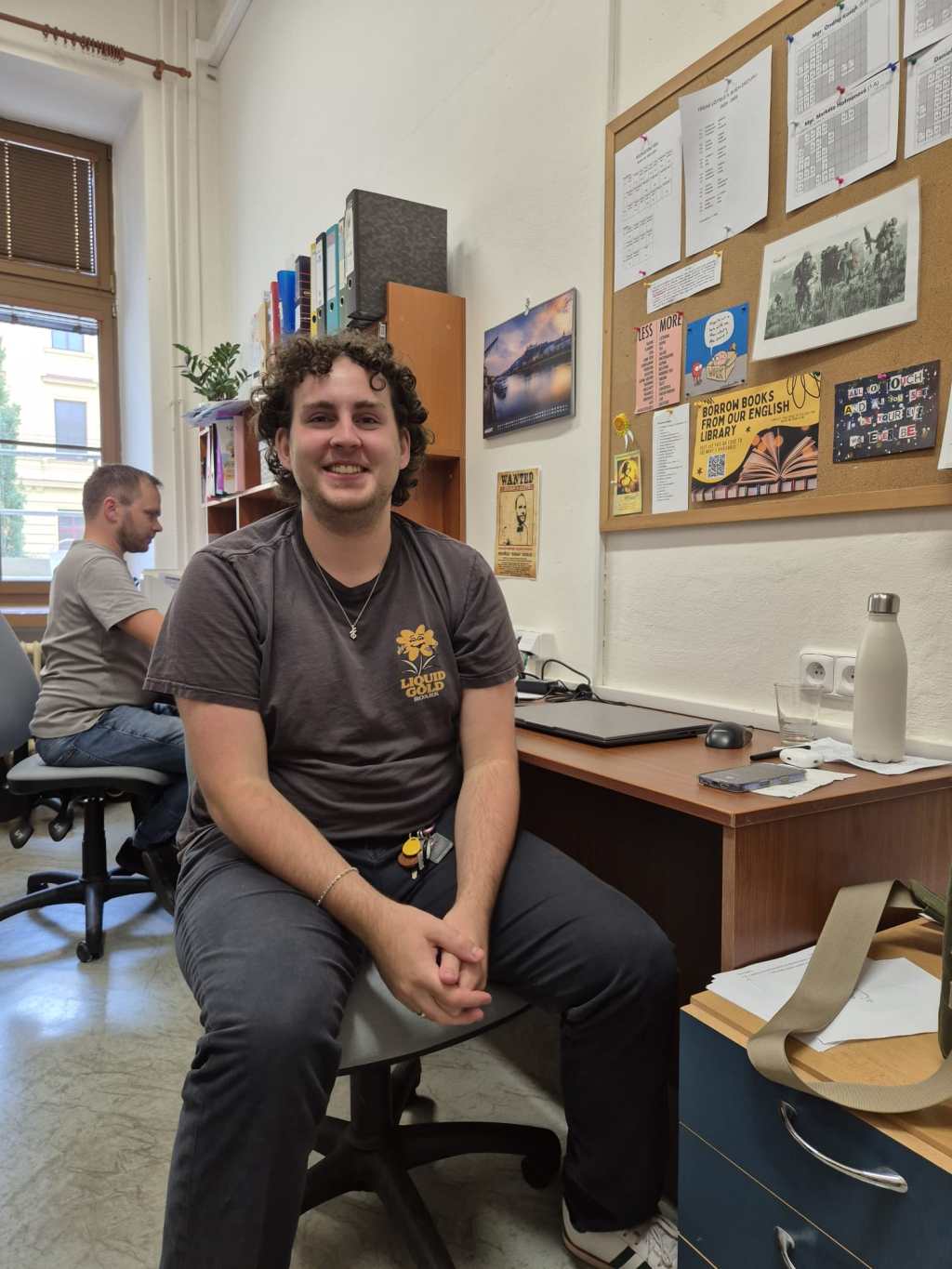
Charlie Allen has been the new Fulbright assistant at Gybon since the beginning of September. For one year, he is helping English teachers during classes and offering extra conversational lessons. He even played Kingdom Come: Deliverance in preparation for his time in the Czech Republic. Does he know some Czech words? Are Americans really that bad at Geography? The school magazine Gybonoviny had an interview with the new native speaker.
anezkakryslova, ondrejbrezina
How do you like our school?
It’s been really good so far. It has a similar feeling to my high school, in terms of the quality of students, which is to say really impressive students. The quality of teachers is also really good, and everyone staffwise has made such a positive effort to try and make me feel integrated even though it’s only been three weeks. The students have also been very nice too and are trying their best to speak in English, especially the younger ones I work with.
You have said that the teachers are really good here. So, where’s the difference between the American teachers and the teachers here?
I think it’s a complicated answer to be honest. I think the educational system is definitely quite different, which I think then contributes to the teachers being a little bit different. In the US recently, even during the time that I was being educated from roughly 6 to 18 years old, it switched from being essentially a teacher talking ‘at you’ for 40 minutes, to being much more of a seminar-style. So, I think there are elements of that here, but maybe not as much as I had towards the end of my time in high school. So, I think the style of teaching is different, but the quality is still comparable for sure.
You have also mentioned that there are also some differences between the American and the Czech educational system. What’s the biggest one?
In terms of here, one thing that, maybe isn’t the biggest but it’s the one that always catches me a little off guard, is that all the students stand at the beginning of every lesson. It freaks me out a little because I forget that I’m not in an American classroom and I’m like, “Whoa, why is everyone standing?” But I think it’s a nice gesture of respect here that we just don’t have in the US. Overall though, I think the ways in which you all are tested as students is very different in the US. Here, you have the maturita exams and then college entrance exams which are you know through the state. Whereas in the US, we don’t really have a ‘school leaving exam’ at all, and then the college entrance exam is a private standardized test. I don’t know if you’ve heard of the SAT or the ACT, but having a good score on that really helps you get into college, but it’s not through your school at all.
Is there any difference in the amount of knowledge that the Czechs are learning compared to the Americans?
Yes. I think this kind of school, a gymnazium, is similar to the normal American high school in the sense that, although I don’t know what your requirements to graduate are, in the US we have to take English, math, science, and history ‘core classes’ for the whole time that we’re in high school.
Whereas, I know at technical schools or pre-professional schools, you specialize a lot earlier. So I think for those schools, those students learn more very useful or technical information than the average American high schooler does, but they’re also learning less in other ways. They’re learning deeper in one area rather than learning a large spread of different things. Which is useful if you want to be a professional, like if you’re going to become a tailor or plumber or things that require a very specific set of skills that you know very well. That system makes a lot of sense.
In the US, if you were going into a similar career, you would go to a technical college, which comes after high school, so you get to start earlier here. But I think you go to school roughly the same amount that Americans do. I think just there’s a wider spread of different things you could be learning here depending on what school you go to.
In Europe, we are also having fun with your geography. What is your opinion on that? Do we need so much information about geography?
I mean, probably not. If you’re going to be living here your whole life, it doesn’t really matter whether you know where Kansas is. As an American teacher, I think it’s most important that Czech students start to realize how big the US is. I think there’s value in learning about the huge differences between certain areas in terms of the geography. You have the Rocky Mountains, you have a lot of swamps, and you have Hawaii which is gorgeous. But necessarily knowing the US is x square miles in size… I don’t personally see the value in that. But I think that’s more my stance as an educator
Really I’m much more in favor of processing-oriented learning rather than needing to know specific things like x y and z. So, I think it’s my personal bias but I was surprised at least that there’s so much focus on American geography even in the English classes. In fact, I think some of my first lessons are about geography so you’re stuck with it I guess.
Why do you think that Americans don’t know about geography as much as we do?
I think it’s a bit of a misconception to be honest. I think we are probably really bad at the geography of Asia and of Africa, which I think reflects some biases in our educational system. I think some people who are setting the educational curriculums in the US have decided that these places are less valuable to learn about, which is a value judgment that I would say is wrong. I think in short the American system is moving towards preparing the individual rather than preparing the knowledge, so geography and being like, “I can find these eight countries on a map,” is declining in value as a skill set because we live in a world with Google.
Also though, I think the American educational system is so fractured in a lot of ways. You all have a centralized Ministry of Education, Youth and Sports. We have a Department of Education which doesn’t really decide what people learn. It just kind of sets broad guidelines and now, under the current administration, those are getting shakier. But a lot of what people learn in the US is based on the town that they live in and broadly the people from the town decide the curriculums for different things.
So, if I understand it correctly, people from California learn something different than people from Massachusetts.
Yes it can definitely happen and, even if it isn’t different in terms of the facts, it might be different in terms of how it’s taught or it might be different in terms of what’s emphasized. Which, I think is true everywhere because obviously the person who has the most say over a lesson is the teacher because they’re the one delivering it, and they can leave out things, they can add things, they can tell you what they think is important. But from my understanding, the US as an educational system is much more what we call federalized, which is where we spread things out to the states rather than having it be a central top down system.
Why did you come here to the Czech Republic? There are more interesting countries to go to.
I feel the same about where I grew up, that sort of lack of interest, so I definitely understand the question. So in terms of a Fulbright, it’s a very prestigious thing in the US. For anyone who works in the educational field, it’s probably the highest prestige thing that we have for young people in education, and I knew that I wanted to apply for it. Then, you have to apply to a specific country, and the reason why I chose the Czech Republic is sort of a combination of more personal reasons and then also some pragmatic or more logical reasons.
Chief among the logical ones is that I don’t speak a foreign language yet, you know, but hopefully soon now. In other countries like France or Spain, you need to know the local language in order to teach much younger children than here. In contrast, Czech isn’t taught in US schools at all, so the foreign language requirement wasn’t a thing for Czechia because the view is more, “We’ll put you with older students who will know some English so you can just come in and be a resource”. And then more personally, I also have a degree in history and my favorite era is European medieval history, so the Czech Republic seemed like a good fit where I know I can spend my time here well, instead of maybe wasting it in a place that I’m not as interested in.
Can you go only to the Czech Republic when taking part in Fulbright?
No. For the global Fulbright program, there are a number of different things that you can do as a Fulbright scholar or a Fulbright fellow. You also get a lot of people who are much older than me, like American professors who come and teach in foreign universities as Fulbright fellows. For my program, being a Fulbright English Teaching Assistant, you could be sort of a real teacher or more of a beginner teacher like me. You go and help teach English wherever. You can be a student, so you’ll get some American university students who will essentially study abroad in different countries for a year. You can also have the inverse, where you have people from other countries come to the US for similar things
Country-wise, there’s a spread of at least a hundred countries you can go to for your Fulbright. At my college, we had a lot of people who were awarded English Teaching Assistant spots this year. Four of them went to Taiwan I believe, and one is in the Canary Islands off the coast of Morocco. You can essentially go to pretty much any country in Europe except for the UK, because they obviously know how to speak English already. There are also opportunities in a lot of countries in Africa and Asia, and then you can definitely go do research in Oceania. I know of a lot of people doing research for ecology in New Zealand for example.
So the reason why you decided to join the Fulbright program was because it’s sort of a prestigious thing?
That was definitely part of it. I wasn’t really sure what I wanted to do after college because I went to a liberal arts college, which in the US is a very broad style of learning. I have a degree in Classics and History, which also does not have a very clear job progression in the way that a ‘pre-med’ track leads into medical school. So, I was kind of thinking like, “Okay I have a lot of background in education, I’m probably not going to get this Fulbright, I might as well apply to it and just see what happens.”
I mean obviously the prestige element was still a factor, but I also think it will just be a great experience and opportunity. I studied abroad a couple years ago in Greece, and I loved it and grew so much from it. I’m also half British, so until a couple years ago with Brexit, I was planning to live in Europe at some point in my twenties anyways, so this was a nice way to still do that. I think it’s just such a unique opportunity that when I got it, it was very hard to pass up and obviously I didn’t.
“I’m not setting expectations. I’m allowing things to happen”
What are you expecting from your stay in Czechia?
I don’t know.Lately, as a little philosophy thing, I’ve been trying to do a better job about not setting expectations and just allowing things to happen. I think a lot of times when you set expectations, there’s a pressure to meet them. Don’t get me wrong, there are definitely things that I want to do here. I want to maximize my time and go to a lot of different towns, see castles, you know, the nerdy things. But in terms of goals, sometimes I feel like goals can kind of constrain you in a way. I might realize something like, “Oh, I’m behind on learning Czech.” Learning Czech is still something that I want to do, but there can be so much pressure sometimes that comes with goals and expectations that I’ve been trying not to have as many of them. Overall though, I think it’s such a cool experience that I’m going to have a great time no matter what.
Do you have some castles that you want to visit here?
Yes, I really want to see Trosky Castle. I played the Kingdom Come: Deliverance games as a sort of light-hearted preparation for my time here. So, I want to go see some of the other castles from those games. I also really like cathedrals. The cathedral here in Hradec is gorgeous and I know there’s a really beautiful one in Kutná Hora that I want to go see as well. I think it was being constructed in the second game’s time period, so I haven’t seen it yet, but it should be good. And then I saw Prague Castle and then the cathedral that’s up there when I was studying abroad one weekend, and I know those are usually on people’s bucket lists, so I’ve checked them off and now I’m going to all the smaller ones.
You have also mentioned that you are trying to learn Czech. Have you already learned some Czech words? Which ones?
Essentially only the ones for grocery shopping because that’s my primary exposure to the outside world. So on the plus side, I can now confidently navigate around a grocery store. Speaking wise, I’m not very good, but reading-wise I’m getting there a little bit. Because I also studied Latin and Greek in college and high school, I never learned a spoken language, which means that that part of my brain is a bit underdeveloped. So I’m working on it, but I have not gotten as far as I hoped yet.
What’s the hardest thing for you to adapt to in the Czech Republic?
That’s a really good question. I don’t think it’s a Czech specific thing, because this is also a moment of change in my life. This is the first job that I’ve had after college, the first time that I’m not living with all my friends, things like that. I think no matter where I ended up, it was going to be challenging just sort of like being a bit isolated from other people and not having the social support system I grew used to in college. I’ve been blessed with amazing relationships with all of the friends that I made in college, so it’s the first time I’ve ever not lived with them which is hard. It’s also exacerbated a little because of the fact that I’m in a place where everyone speaks Czech, and everyone assumes that I’m Czech. It’s a little rough to try and make new connections in this place specifically, but I think it’s not the cause of the issue as much as it’s just a sort of facet of the issue.
“I miss the food. ”
How do you find teaching in a school that uses British English as an American?
It’s interesting. My dad is English, so I think I have a leg up a little bit compared to some of my colleagues teaching in other schools. There are certain moments where the teachers here are teaching from a textbook and I’m thinking, “You wouldn’t say that in the US”, but it’s still grammatically correct. Also, I think you all are mostly going to be speaking to people speaking or educated in British English, so there is definitely merit and value in learning it. I mean, it’s all still English, just with different vocabulary. I just try to add sometimes, you know, “In the US we might say this a little bit differently” and then provide an example, but it’s still valuable to learn for sure and it reminds me of my dad, so it’s nice in that way.
What do you miss the most from the USA?
The food most of all. I’m cooking for myself, so it’s partially me to blame, but my American family is from Colorado, which is sort of just above Texas, so we get a lot of Mexican food out there. There are also not a lot of available ingredients here that you can use to make Mexican food. So, I’m missing that element of it. The Czech food that I’ve had already is also really good, It’s just y’all also have very big lunches. I’m much more of a smaller lunch person. It’s little things about the food that I’m getting used to. My mom is also an amazing cook, so I miss her cooking for me especially.
What are you cooking here? Are you trying to find the ingredients for meals that you know from your country, or are you trying to make some new recipes that you can make from the ingredients that you can buy here?
It’s been a mix of both. This is also, again, a cultural difference. In America, a lot of times colleges have canteens built into them. The one at my college was amazing, where it’s like in the top five dining halls in the country, with really high quality food. So, this is the first time that I’m having to really cook for myself on a regular basis. I’m trying to use familiar things. I’m like, „Okay, this is how this should taste. I didn’t mess it up too bad.“ And then also being like, „Okay, I saw this very oddlooking thing in the grocery store. Let me try and cook it and then succeed or fail.” I think it’s been a mix of just trying to get into a rhythm of cooking and then also being like, “I’m here. I should explore a little bit.”
Did you want to become a teacher when you were a child? If not, what did you want to do instead?
No actually, I only decided I want to be a teacher in my freshman or sophomore year of college. I mean, even now, the job I’ll be working next year in the US isn’t teaching either. So, this is probably my last year teaching for a little while probably. When I was a kid, I really wanted to do something with American football. Even until my first year of college, I was like, “I’m going to coach American football in college or the NFL someday.” I think there’s a lot of overlap between coaching and teaching, like coaching is a subset of teaching. I think my personality has always been more of a helping or supportive one, and teaching naturally fits that, but I definitely didn’t picture myself teaching for a while. And then I was like, „Oh, if I want to coach football in American high school, often the salaries aren’t great, so you normally teach as well.” So I was like, „Okay, I can teach history and be an American football coach.“ But then I quit football in college, so the pivot was, „No, I’ll just be a teacher.“ And then, at the beginning of last year, I had a sort of a crisis of faith, where I didn’t know if I wanted to teach anymore. I sort of had to scramble. I was like, “Okay, what other jobs can I find and be good at?” And then Fulbright came through and I decided, you know what, I’ll teach for a year. It’s a profession that I enjoy. I just also don’t know if I’m going to do it for the rest of my life.
“Being ‘spiritual’ is a very American thing.”
How would you rate the level of English of Czech students?
It’s been really good. I was very pleasantly surprised. I mean, you two are both very well spoken. And people’ve been saying hello to me in the hallway, which is always surprising and a little bit of a jump-scare. I went into this being like, „Okay, we’re going to be on the struggle bus a little bit,“ which is another American idiom. But it’s been really good. Candidly, I think the students may like me a little bit more because I’m a break from their normal teachers, and I get to come in and have fun and not have to do all the grammar, testing, etc. The students so far have been really engaged, which, when you’re engaged, you want to talk more. When you want to talk more, your English gets better, so it has worked out well.
What do you like to do in your free time?
Normally, I am definitely a social creature, so I like to hang out with my friends back in the US. I feel most myself around them, and also just having fun whether it’s out going to a bar now that we’re all legal back home or just spending some of the nights of my senior year just in our dorm room hanging out. So, something like that, or I play some computer games, but I also like to draw, so I’m hoping I make more time for that here. And then here specifically, I’m still getting used to everything. So, it’s been mostly cooking to break up the boredom. But, I am hoping that I get to draw. I’ve been journaling, which has been nice because it’s been something that I’ve always wanted to do, but never made the time for.
Is there anything that inspires you in general?
I think what motivates me in how I live my life and how I interact with people is just having faith. I’m not religious but more ‘spiritual,’ which I’ve heard is also a very ‘American’ thing. Anyways, I do truly believe that everyone is a good person, maybe mostly because I think living in a world where that isn’t true is too depressing or grim. I’d rather believe it even if it isn’t true. So I think what inspires me is choosing to believe that everyone is a good person, and then you get a chance to meet and interact with so many good people on a day-to-day basis.
I also have a classics degree, so I’m also going to cite something from ancient stoicism. There’s the modern version of stoicism too, but I don’t agree with it very much. It’s very ‘gym-bro’ and heteronormative, which is frustrating if you’ve read the actual source texts. Essentially there’s this concept of what’s called a “macrocosm” and a “microcosm,” which is the idea that you yourself and everything within you is a reflection of the entire universe. I think that’s very cool. So I just try to remember that, and that you have everything you need for each moment of your life within you even if you don’t know it’s there.
 Gybonoviny